

Runaway Athletics Spending Threatens the Financial Health of America’s Colleges, Cantwell Snapshot Report Shows
94% of Division I programs are in the red, spending more than they generate; schools faced approx. 300% higher costs for recruiting, equipment and coaching since 2005
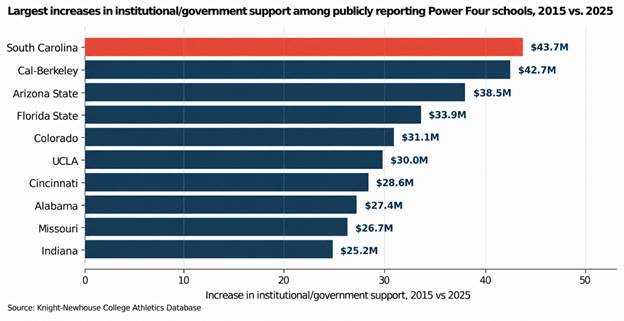
Universities and state governments are footing the bill, boosting spending by $520 million across 53 Power Four athletic programs alone in 2025 vs. 2015
Senate advanced bipartisan Protect College Sports Act, which would stabilize college sports
WASHINGTON, D.C. – Today, U.S. Senator Maria Cantwell (D-Wash.), Ranking Member of the Senate Committee on Commerce, Science and Transportation, released a new snapshot report on how runaway athletics spending is harming the financial health and broader missions of U.S. colleges and universities – and hitting students with record-high fees.
“This report demonstrates how the unsustainable growth in spending on college sports is amplifying the broader financial pressures on colleges and universities,” said Sen. Cantwell. “We’re seeing universities transfer general fund money to cover athletic department deficits, dip into endowments to sustain their general funds, and beg state legislatures for even more sports dollars. We must rein in runaway athletics spending or face the consequences of a brain drain that threatens our global leadership in science and technology.”
The report contains a new analysis of the increase in government and institutional support to our leading public universities. According to this analysis, leading universities now contribute a half-billion dollars more towards athletics each year than they did ten years ago. Contributions from general funds to support athletics among Power Four schools nearly tripled from 2015-2024, increasing from $445 million to $1.2 billion.
Other findings outlined in the report:
- 94 percent of all Division I athletics programs now spend more than they generate in athletics revenue.
- Only 14 of 53 publicly reported Power 4 athletic departments generated enough revenue to cover expenses in 2024–25.
- The percentage of annual operating budgets being funded by endowments reached an all-time high of 15.2% in FY 2025, a significant increase from 10.9% in FY23.
- In the 2023–24 academic year, 87 percent of non-power-conference colleges required all students to pay mandatory fees to fund athletics, along with 48 percent of power-conference colleges. At James Madison University – a public university in Virginia – 74 percent of the athletics budget came from mandatory student fees, which cost students $3,011 per year.
- Within the past two years, legislatures in Connecticut, Wisconsin, New Jersey, Arkansas, Louisiana and Florida have earmarked state tax dollars, raised taxes or created significant tax breaks to benefit college athletics.
Sen. Cantwell is leading the effort to reform college sports and ensure tomorrow’s athletes have the same opportunities as today’s competitors, without sacrificing the educational and research endeavors of these institutions that are the lifeblood of our economic competitiveness.
In September 2025, she released a new analysis of college sports TV revenues showing how skyrocketing media rights payments have exacerbated a massive financial gap between traditional power conferences, especially the new Power 2 – the SEC and Big Ten – and everyone else.
On September 14, she joined Gonzaga University head men’s basketball coach Mark Few, and current college athletes, coaches and senators rom both parties to speak in support of the Protect College Sports Act.
The Protect College Sports Act of 2026 sets new rules and provides new tools to stabilize college sports, including codifying athletes’ rights to earn compensation for their NIL, enshrining scholarship and healthcare protections in law, reining in predatory agents, expanding revenue for all schools and preserving and protecting the future of women’s and Olympic sports.
In June, at a landmark hearing on the bill, the Commerce Committee heard powerful testimony on the worsening crisis facing college athletics, including the future of women’s and Olympic sports, athletes’ rights and the financial sustainability of the entire collegiate sports system.
In December of last year, she introduced the Helping Undergraduate Students Thrive with Long-Term Earnings (HUSTLE Act) with Senator Marsha Blackburn (R-Tenn.) so that college athletes earning NIL (Name, Image, Likeness) money can protect more of it for their post-playing lives.
In October, Sen. Cantwell joined former college and professional athletes and Senators Cory Booker (D-N.J.) and Richard Blumenthal (D-Conn.) in warning that the SCORE Act would roll-back hard fought NIL rights and health protections, leave athletes vulnerable to unscrupulous agents, short-change women’s and Olympic sports, and shut the door on collective bargaining rights.
Last September, Sen. Cantwell, joined by co-sponsors Sens. Booker and Blumenthal, introduced the Student Athlete Fairness and Enforcement (SAFE) Act to codify athletes’ rights and protections in law, expand revenue for all schools, support women’s and Olympic sports and bring much-needed stability to the college sports system.
###
Legal Disclaimer:
EIN Presswire provides this news content "as is" without warranty of any kind. We do not accept any responsibility or liability for the accuracy, content, images, videos, licenses, completeness, legality, or reliability of the information contained in this article. If you have any complaints or copyright issues related to this article, kindly contact the author above.
